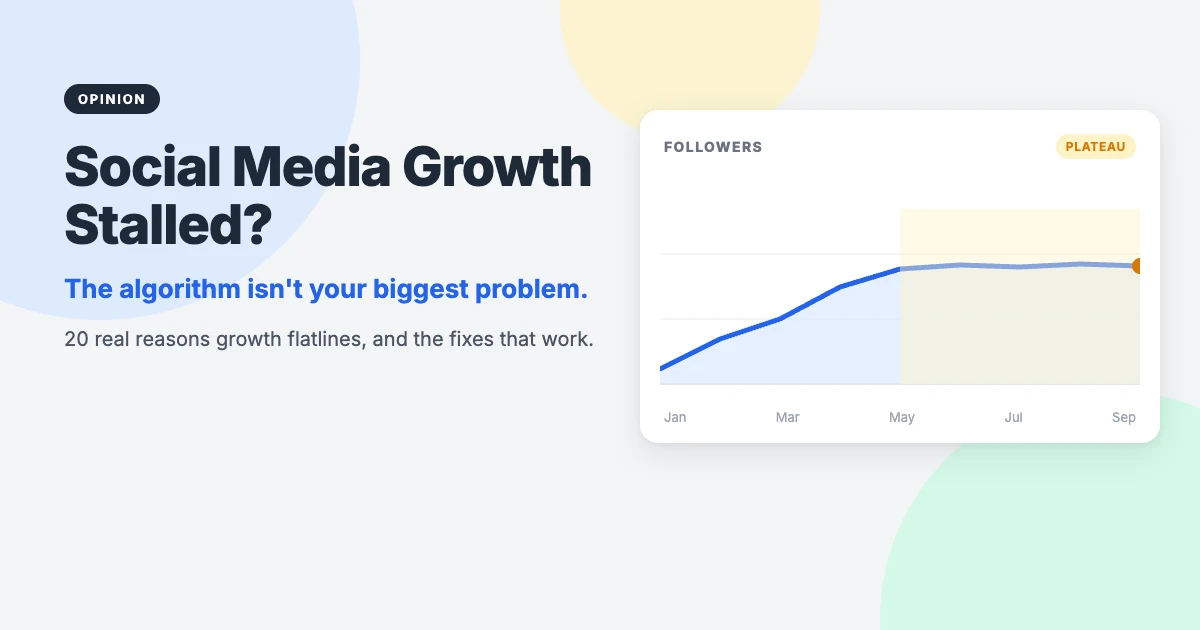
When social media growth stalls, the algorithm is the easiest thing to blame. Your reach drops, your follower count flatlines, and it feels like the platform has quietly decided to stop showing your posts. Sometimes that’s partly true. Most of the time, it isn’t the whole story.
Adam Connell argues exactly this in his Blogging Wizard article on why your social media growth stalled. He lists 20 reasons, from inconsistent posting to buying followers, and almost all of them are things you control. We agree with most of his list. Where we’d push further is on what you do with the audience once you’ve grown it.
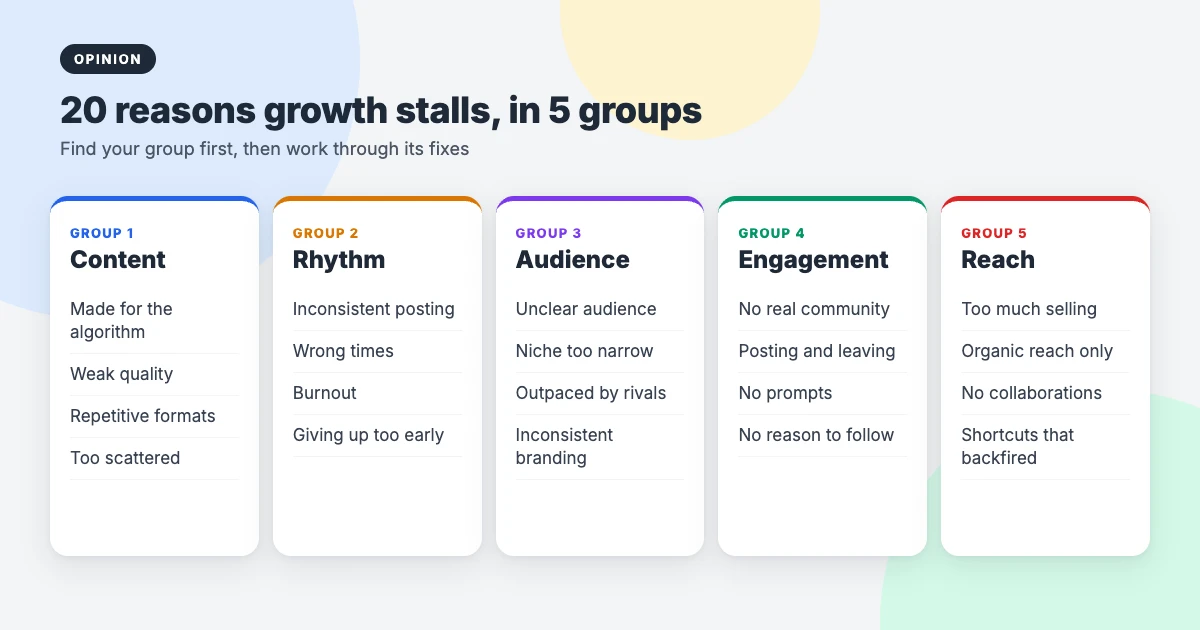
In this opinion piece, we’ll group the 20 reasons into five problems you can actually diagnose, share where we agree and disagree, explain why every blogger and business on WordPress should treat social media as rented space, and suggest a simple weekly routine with free tools.
Our take at a glance
| Problem | Typical signs | First fix to try |
|---|---|---|
| Content | Posts get seen but ignored | Make each post useful to one specific person |
| Rhythm | Bursts of posting, then silence | A schedule you can keep for six months |
| Audience | Likes from the wrong people | Decide exactly who you’re talking to |
| Engagement | Views, but few comments or follows | Reply to everyone and give a reason to follow |
| Reach | The same small circle sees everything | Collaborate and promote beyond the feed |
| Ownership | Followers, but no visits or sales | Move people to your site and email list |
Is the algorithm really not the problem?
Mostly, yes. Social media growth comes from posts that people stop for, react to and share, because that’s what algorithms reward. If your posts aren’t getting those signals, the algorithm is simply reflecting that back to you. Blaming it feels better than admitting the content isn’t landing, but it doesn’t help you fix anything.
That said, we’d be honest about the other side. Platforms do change the rules. Many marketers believe posts with external links reach fewer people, and formats go in and out of favour. When that happens, your effort stays the same while your results drop. The answer isn’t to give up on social media. It’s to stop depending on it entirely, which we’ll come back to.
Start by finding which number stopped growing
Twenty possible causes is a lot to work through. Before you change anything about your social media growth plan, look at your analytics and find which number actually stalled. Each one points to a different group of fixes.
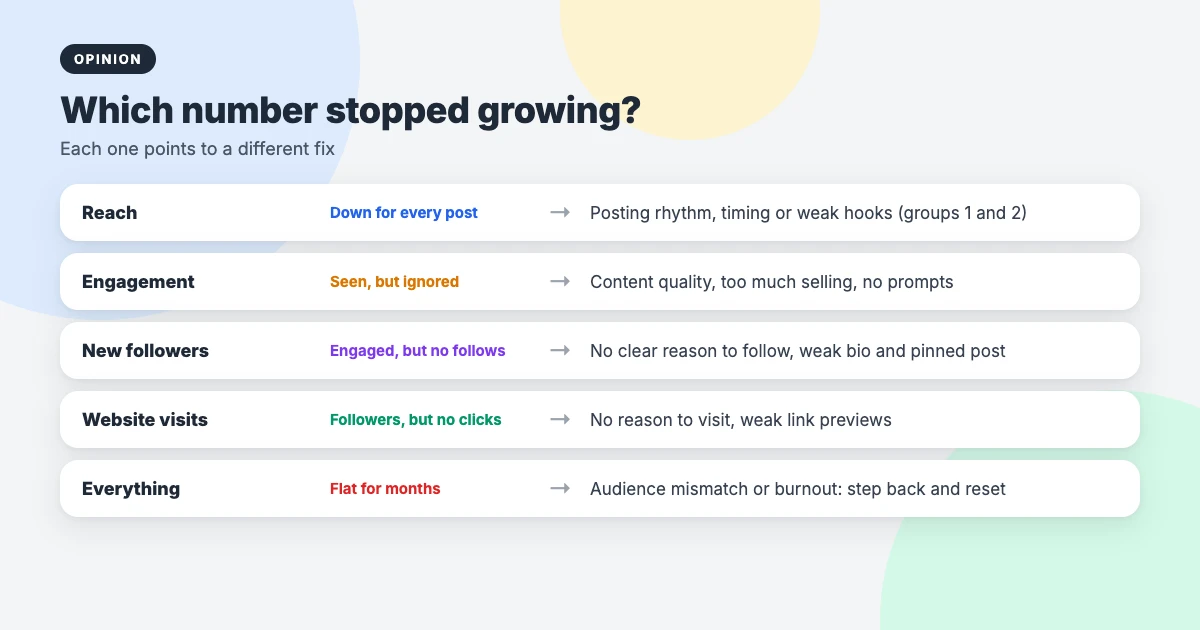
If reach is down across every post, look at your rhythm and the first few seconds of each post. If people see your posts but don’t react, it’s a content problem. If they react but don’t follow, your profile isn’t giving them a reason. And if you have followers but almost nobody visits your website, the issue is what happens after the scroll.
The 20 reasons social media growth stalls, grouped
Here are the original 20 reasons, sorted into five groups, with our view on each group.
1. Content: made for the algorithm, not for people
This group covers chasing trends and hashtags, weak content, repeating the same format and posting about too many unrelated topics. It’s the most common cause of stalled social media growth, and the hardest to admit.
Our view: write every post for one specific person with one specific problem. Look at your ten best-performing posts, find what they have in common and do more of it. Then change the format, not the topic: a tip that worked as text can become a short video, a carousel or a quick poll.
2. Rhythm: inconsistency, bad timing and burnout
Posting in bursts, posting when your audience is asleep, burning out and giving up too soon all belong here. Connell recommends committing to at least six months before judging the results, and we think that’s exactly right.
The trick is choosing a pace you can keep. Three good posts a week that you keep up for six months will beat two posts a day that stop after three weeks. Use your platform’s own insights to find when your followers are online, then schedule posts for those times.
3. Audience: unclear, too narrow or outpaced
An unclear audience, a niche that’s too small, competitors who move faster and inconsistent branding make up this group. Interestingly, two of the original reasons pull in opposite directions: be more specific, but don’t be so narrow that you run out of people.
Our view: be specific about who, and flexible about what. A WordPress blog for small business owners can talk about websites, marketing, tools and running a business without losing focus, because the reader stays the same.
4. Engagement: posting and disappearing
No real community, not replying to comments, never asking questions and giving people no reason to follow are all in this group. This is where we’d spend the most time, because it’s the cheapest fix with the fastest results.
Spend 15 minutes a day replying to every comment and message. Ask one real question in each post. Then check your profile: does your bio say who you help and what they’ll get by following? Is your pinned post your best work? If not, fix those before posting anything new.
5. Reach: selling too much and growing alone
The final group covers too much selling, relying only on organic reach, never collaborating and shortcuts such as buying followers or joining engagement groups. The original suggests roughly 80% helpful content and 20% promotion, which is a sensible rule of thumb.
We’d add a firm line on shortcuts: never buy followers. They don’t engage, which tells the platform your posts aren’t interesting, and they make every number you track meaningless. Collaborating with people of a similar size in your niche is slower, but it brings you real followers who actually care.
Where we’d go further: own your audience
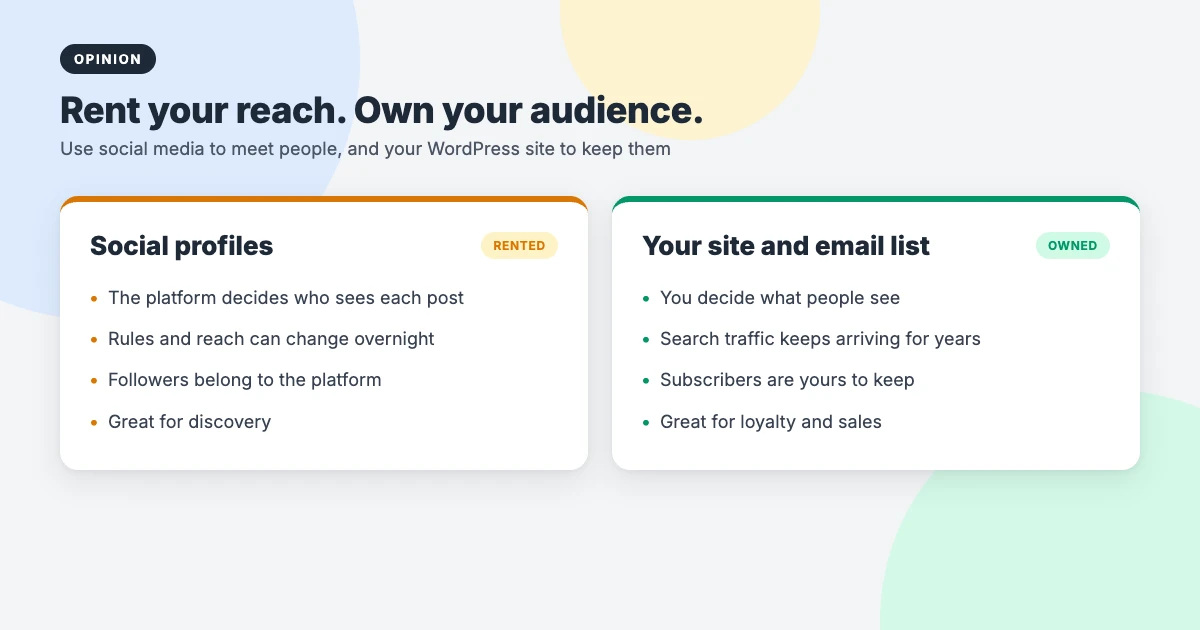
This is our biggest addition to the original article. Even if you fix all 20 reasons, your social media growth still happens on someone else’s platform. The platform decides who sees each post, can change the rules overnight, and technically owns the relationship with your followers.
So use social media to meet people, and your WordPress site to keep them. Every follower who joins your email list or bookmarks your blog is someone you can reach without asking an algorithm for permission. Search traffic to your site also keeps arriving for years, long after a social post has disappeared from the feed.
In practice, that means:
- Give social followers a reason to visit your site. Share the useful part on social media, and keep the full guide, template or checklist on your blog.
- Add an email sign-up to your blog. A short form after each post is enough to start.
- Write headlines for the feed. Our opinion on why SEO headlines fail on social media explains how to give each post a second headline for sharing.
- Measure visits, not just likes. Check how many people arrive from each platform in Google Analytics. Our comparison of Google Analytics vs Jetpack Stats covers the free options.
Free tools that make consistency easier
The original article recommends several paid tools. You don’t need them to get started. These free options cover scheduling, sharing and email:
- Meta Business Suite: schedule Facebook and Instagram posts and see when your followers are online.
- LinkedIn’s built-in scheduler: click the clock icon when creating a post to choose a date and time.
- Buffer: the free plan covers 3 channels with up to 10 scheduled posts each, which is plenty for a small blog.
- Jetpack Social: automatically shares new WordPress posts to your connected social profiles. Auto-sharing is included in the free plan.
- MailPoet: build an email list inside WordPress. It’s free for up to 500 subscribers.
A weekly routine you can keep for six months
Most stalled social media growth comes down to effort that isn’t sustainable. Here’s a routine that takes about two hours a week and is built around one blog post, so your social media and your website grow together.
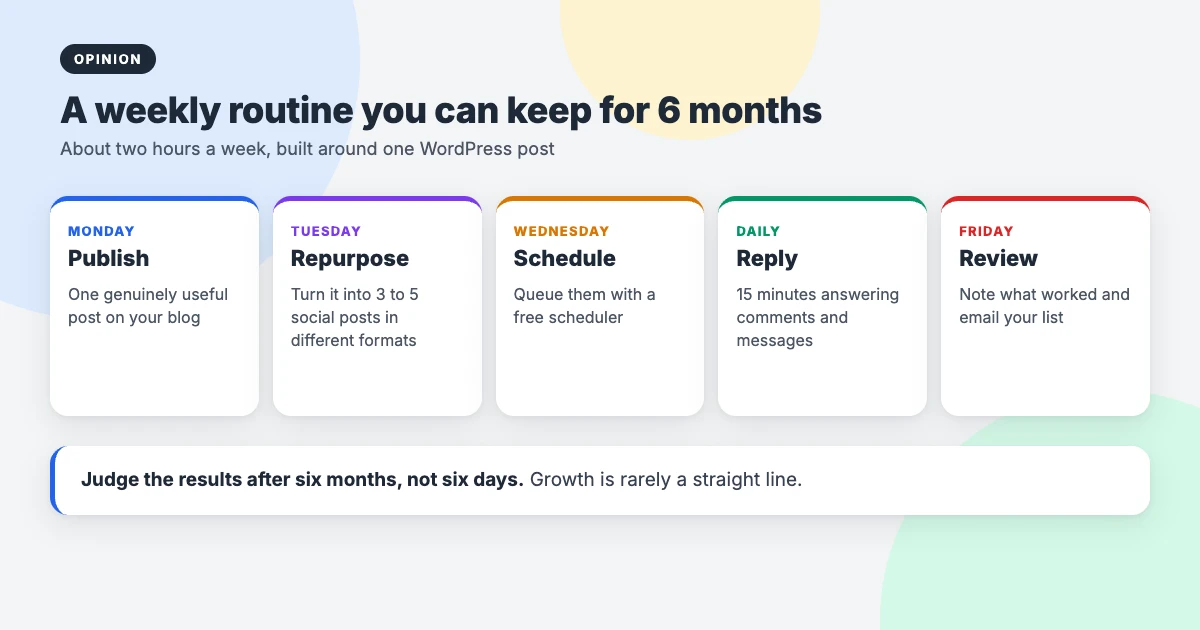
- Monday: publish one genuinely useful post on your blog.
- Tuesday: turn it into three to five social posts in different formats.
- Wednesday: schedule them with a free tool for when your followers are online.
- Every day: spend 15 minutes replying to comments and messages.
- Friday: note which post did best, and send a short email to your list.
For more ideas on getting each post in front of people, see our guides on how to promote your blog and how to get more blog traffic.
Fast themes for the traffic social media sends
Most social media visitors arrive on a phone, often inside an app’s built-in browser. A slow page wastes the click you worked hard for. These WPInterface Pro themes are built to load quickly on mobile.
SpeedBlog Pro
SpeedBlog Pro is a fast blog theme for travel, tech, personal and creative blogs, with a clean layout that keeps readers focused.

BlogSky Pro
BlogSky Pro is a minimalist blog theme with a post list and slider hero, Must-Read Highlights and RTL support.

Business Interface Pro
Business Interface Pro is a lightweight multipurpose business theme with 12 starter sites, for businesses turning social followers into customers.

You can see all our themes on the WordPress themes page.
Need a hand?
If you’d like your website ready to turn social followers into readers and customers, the WPInterface team can help at a fixed price:
- News and Blog Website Setup: we build your blog on a fast WPInterface theme, ready to publish and share.
- Must-Have Plugins Installation: for $59, we install and configure essential plugins, including SEO, sharing and email sign-up.
- WordPress Speed Optimization: faster pages, so social visitors don’t leave before your post loads.
- VIP Support: a $29 priority ticket for quick expert help with any WordPress problem.
Frequently asked questions
Why has my social media growth suddenly stopped?
Usually because of a change on your side: posting less often, a shift in topics or format, or less time spent replying. Check which number stalled first, such as reach, engagement or new followers, to narrow down the cause.
How long does it take to grow on social media?
Give any new social media growth plan at least six months of consistent posting before judging it. Growth often stays flat for weeks and then jumps when a post finally connects with the right people.
Should I buy followers to get started?
No. Bought followers don’t engage, which signals to the platform that your posts aren’t interesting, and they make your analytics meaningless. It can also break platform rules.
How often should I post?
As often as you can keep up with good posts for six months. For most bloggers and small businesses, three to five posts a week per platform is a realistic start.
Can I automatically share WordPress posts to social media?
Yes. Jetpack Social’s free plan shares new posts automatically to connected profiles. Automatic posts work best as a baseline, with a few hand-written posts each week on top.
Is social media or email better for bloggers?
You need both. Social media helps new people find you, while an email list lets you reach them reliably. Use one to grow the other.
Final thoughts
We agree with Connell: when social media growth stalls, the algorithm is rarely the main reason. The fixes are usually unglamorous: clearer content, a steady rhythm, real replies and patience.
Our addition is to build on ground you own. Use social media to meet people, send them to your WordPress site, and invite them onto your email list. Then, when the next algorithm change arrives, your audience is still yours.
Reactions
How did this make you feel?
Be the first to react
One reaction per visitor. Tap again to change or remove it.




Leave a reply