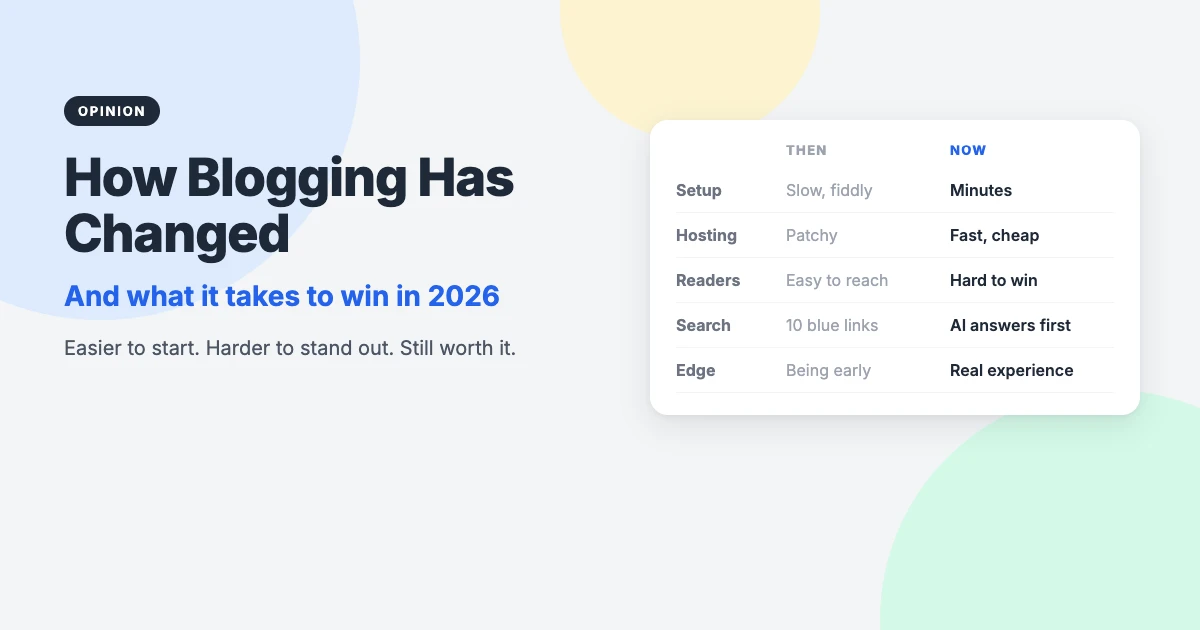
Blogging in 2026 looks nothing like blogging ten years ago. Starting a WordPress blog now takes minutes, hosting is fast and cheap, and AI tools can help you write a draft before your coffee cools. Yet getting people to actually read your blog has never been harder.
Adam Connell reflects on this shift in his Blogging Wizard article on how the blogging landscape has changed and what it takes to win. His answer is refreshingly unglamorous: repeatable work, patience, owning your audience, not chasing money, and genuinely enjoying it. We agree with almost all of it.
In this opinion piece, we’ll share where we think blogging has really changed, what the latest data says about AI search, the habits we believe win today, where we’d add to the original, and the themes and services that can save you time if you’re starting or relaunching a blog.
Our take at a glance
| The original says | Our view |
|---|---|
| Blogging is harder because of competition | Agree. The hard part has moved from technology to attention. |
| It’s a repeatable process, not luck | Strongly agree. Treat it as a weekly loop. |
| Expect it to take a long time | Agree. Judge results in months and years, not weeks. |
| Reduce reliance on Google and social media | Agree, and AI search makes this more urgent. |
| Don’t chase money | Agree, but plan how the blog will earn from the start. |
| Your blogging skills are valuable | Agree. Your blog is a portfolio. |
| AI isn’t a golden ticket | Agree. Use it as an assistant, not an author. |
How blogging in 2026 is different
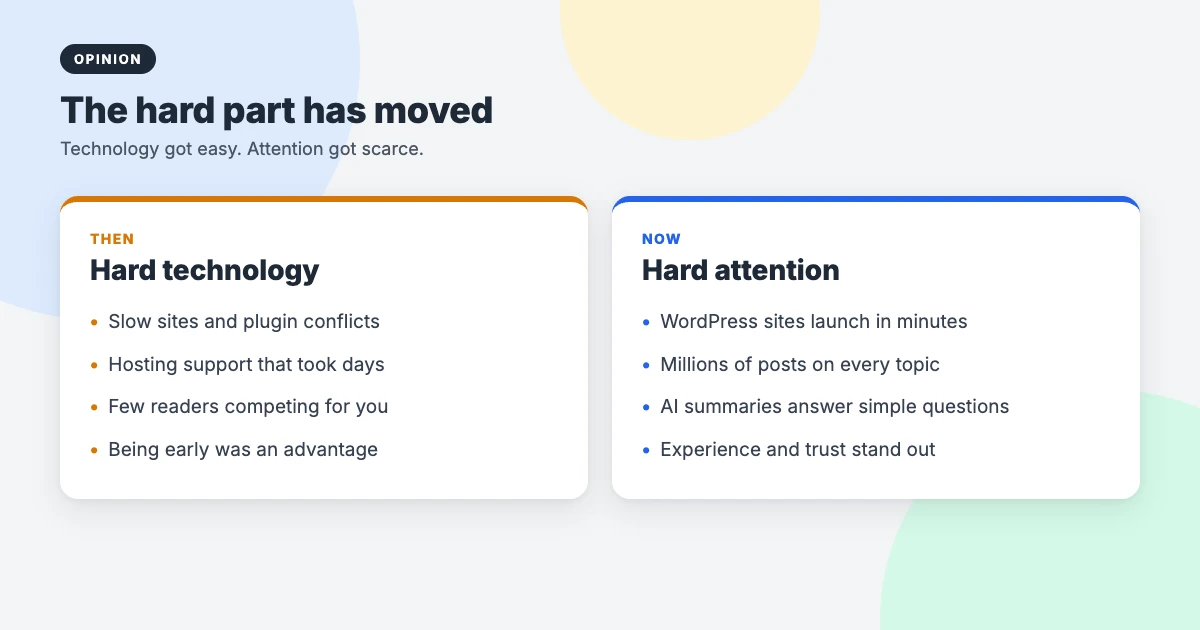
Connell remembers the early days of slow WordPress sites, plugin conflicts and hosting support that took days to reply. Many long-time bloggers will recognise that. The technical side used to be the hard part, and the readers were relatively easy to find.
Blogging in 2026 is the other way round. A fast, good-looking WordPress blog is within anyone’s reach, which means millions of people have one. Every topic has dozens of competent posts. The challenge is no longer building the blog. It’s giving people a reason to choose yours.
AI search changed the rules for simple questions
The original article touches on AI as a writing tool, but the bigger shift for bloggers is AI in search results. A Pew Research Center analysis of Google searches in March 2025 found that people clicked a traditional search result on 8% of visits when an AI summary appeared, compared with 15% when it didn’t.
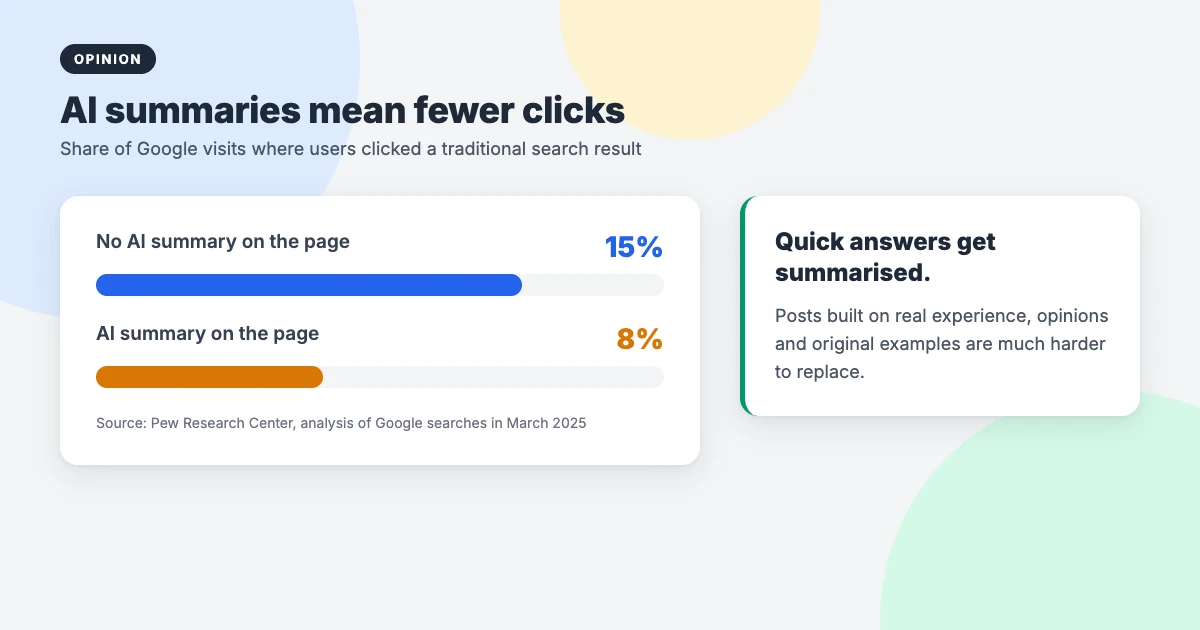
Our reading of this: posts that simply answer a quick factual question are the most exposed, because a summary can answer them too. Posts built on first-hand experience, honest opinions, original examples and step-by-step help from someone who has actually done the thing are much harder to replace. That’s good news for real bloggers.
What it takes to win at blogging in 2026
Here are the habits we believe matter most for blogging in 2026, starting with the ones from the original article and adding a few of our own.
1. Treat it as a loop, not a lottery
Connell’s strongest point is that blogging isn’t a game of chance. Success comes from steps you can repeat: write, publish, promote, learn and improve. Each round teaches you something, and the results compound over time.
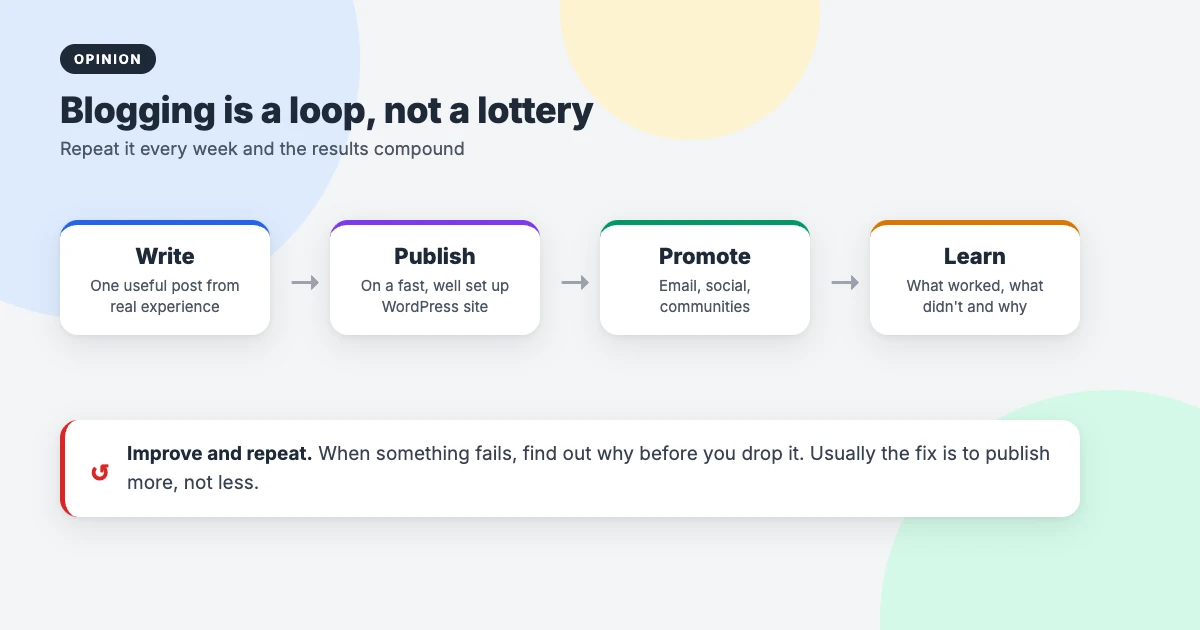
When something fails, don’t drop it after one try. Ask why it failed. Was the topic wrong, the headline weak, or did nobody see it? More often than not, the answer is to publish more and promote better, not to switch strategy.
2. Write what only you can write
This is our biggest addition. With AI summaries and AI-written content everywhere, your edge is the part nobody else has: your experience, your results, your mistakes, your photos and your opinions. A post that says “here’s what happened when we tried this” will always beat a post that lists what anyone could find in five minutes.
3. Use AI as an assistant, not an author
We agree with Connell that mass-producing AI content isn’t the answer. AI is useful for research, outlines, tidying a draft or brainstorming headlines, and it can genuinely reduce burnout. But readers come back for a person, not a prompt. Keep your voice, your stories and your judgement in every post.
4. Own your audience
Google, social networks and AI tools are all rented land. Any of them can change the rules overnight. The original recommends building an email list, and we’d call it the single most important thing for blogging in 2026. Our opinion on why social media growth stalls explains how to move followers onto ground you own.
5. Spread your traffic and income
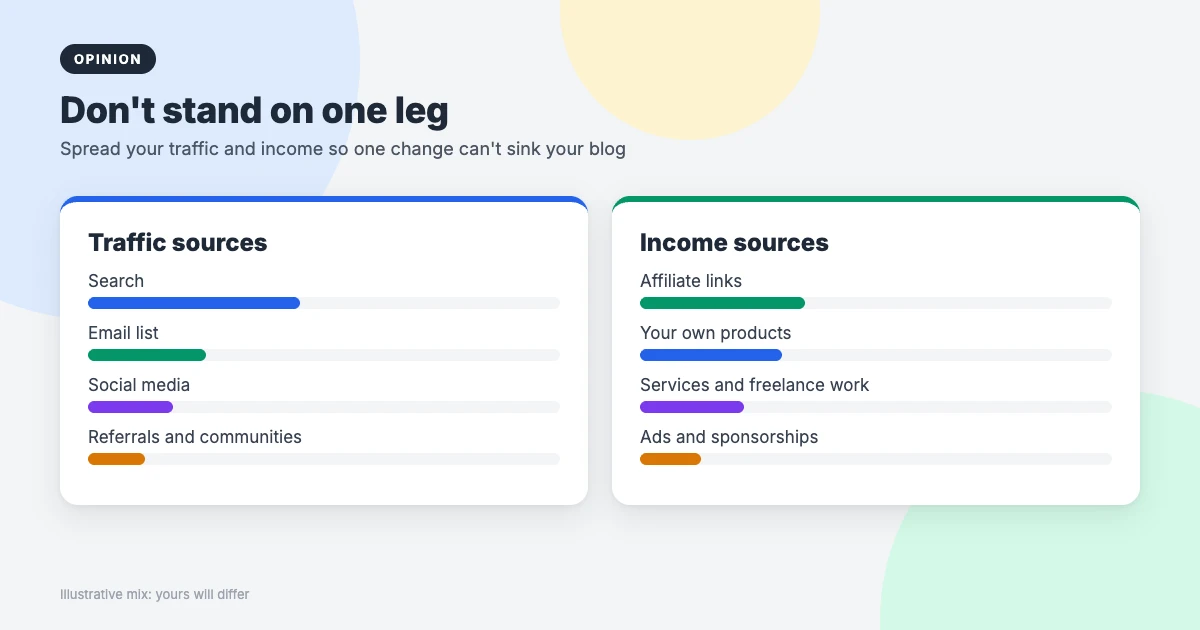
Don’t stand on one leg. A blog that gets all its traffic from Google, or all its income from one affiliate programme, is one change away from trouble. Aim for a mix: search, email, social and communities for traffic; affiliate links, your own products, services and sponsorships for income.
6. Don’t chase money, but do plan for it
Connell warns against checking your earnings every day, and he’s right: it distracts from the work that creates them. Our only nuance is to decide early how the blog will eventually earn, whether through affiliate links, a digital product, services or sponsorships. That way, every post you write moves you a little closer to it, even when money isn’t your focus.
7. Remember your blog is a portfolio
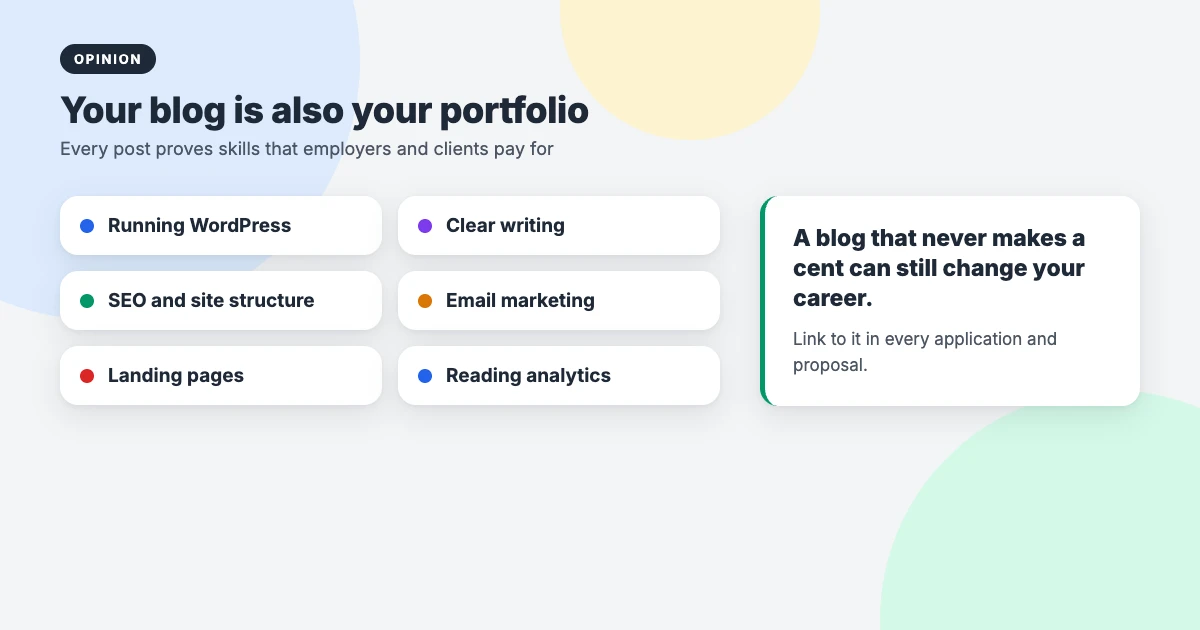
One of our favourite parts of the original is Connell’s story of using his blog to land a marketing job without the usual qualifications. Running a blog teaches WordPress, writing, SEO, email marketing, landing pages and analytics, which are all skills employers and clients pay for. Even a blog that never earns directly can change your career.
8. Enjoy it, or it won’t last
The original ends on heart, and we think that’s the right place. Results take months or years. The bloggers who make it are the ones who enjoy the writing and learning enough to keep going when the numbers are small. If you love the topic, the patience comes much more easily.
Where we’d go further: the boring technical basics still matter
Technology is easier than it was, but that doesn’t mean it no longer matters. In a crowded field, small things decide whether a reader stays: how fast the page loads on a phone, how readable the text is, whether the site looks trustworthy, and whether it’s secure and kept up to date.
Get the basics right once, and you can spend the rest of your time on writing. Our guides on the best fonts for blogs, improving INP in WordPress, hardening WordPress security and getting more blog traffic cover the essentials.
Our blog themes, built for blogging in 2026
For blogging in 2026, a good theme takes care of speed, readability and mobile layouts so you can focus on writing. All WPInterface Pro blog themes are lightweight, RTL ready and work with the block editor. Here are six to choose from.
SpeedBlog Pro
SpeedBlog Pro is a fast premium blog theme with magazine-style layouts and one-click demo import, ideal if speed is your top priority.

BlogNest Pro
BlogNest Pro is an elegant blog theme with a serif masthead, a post slider, Featured Categories and spotlight blocks, perfect for writers who want a classic, editorial feel.

BlogSky Pro
BlogSky Pro is a minimalist blog theme with a post list and slider hero and a Must-Read Highlights section that puts your best posts up front.

BlogAura Pro
BlogAura Pro is a colourful blog theme with a centred masthead, a full-width slider and an Exclusive section, great for lifestyle, food and creative blogs.

BlogLex Pro
BlogLex Pro is a fast blog and magazine theme with a full-width slider, Featured Categories and story blocks, for blogs that publish across many topics.

TruthBlog Pro
TruthBlog Pro is a fast lifestyle blog theme with a full-width hero, story cards, category filter tabs and a post grid.

Still deciding? Compare them in our list of the best WordPress blog themes, or read our opinion on paid vs free WordPress themes.
Professional services for bloggers
If you’d rather spend your time writing than configuring, the WPInterface team can handle the technical side at a fixed price. These are the services bloggers ask us for most:
Launch your blog
- News and Blog Website Setup: a complete blog in 7 days on one of our themes, with editorial roles, ad slots and newsletter sign-up.
- WordPress Installation and Theme Setup: for $99, we install WordPress and set up your WPInterface theme.
- Must-Have Plugins Installation: for $59, we install and configure the essential plugins every blog needs.
- WordPress Theme Customization: layout, style and feature changes made the update-safe way.
Grow your traffic
- Premium SEO Services: a full SEO audit and setup, including sitemaps, schema and on-page fixes, for a fixed $200 in 10 business days.
- Technical SEO for WordPress: crawl and index audits, schema markup, sitemaps, canonical fixes and internal linking.
- Speed and Core Web Vitals Optimization: faster pages, so new readers don’t leave before your post loads.
Keep it running
- WordPress Care Plans: weekly updates, daily off-site backups, uptime and security monitoring, and a monthly report.
- WordPress Migration: move your blog to a better host or from another platform.
- Malware Removal and Security Hardening: clean up a hacked blog and stop it happening again.
- VIP Support: a $29 priority ticket for quick expert help with any WordPress problem.
You can see everything we offer on our WordPress services page.
Frequently asked questions
Is blogging still worth it in 2026?
Yes, if you’re willing to play the long game. Blogging in 2026 is harder to grow quickly than it used to be, but a blog built on real experience still attracts loyal readers, builds an email list and proves your skills to employers and clients.
Has AI killed blogging?
No, but it has changed which posts get clicks. Simple factual answers are often summarised in search results. Posts with first-hand experience, opinions and detailed help are much harder to replace and are where bloggers should focus.
Should I use AI to write my blog posts?
Use it to help, not to replace you. AI is great for research, outlines and editing, but readers return for your voice, stories and judgement.
How long does it take for a blog to succeed?
Usually a year or more of consistent publishing. Plan to judge your results in months and years, not weeks, and keep improving each post based on what you learn.
Is WordPress still the best platform for blogging?
For most serious bloggers, yes. Self-hosted WordPress gives you full ownership, thousands of themes and plugins, and the freedom to earn however you like. Our opinion on whether WordPress is outdated covers this in detail.
What’s the most important thing for a new blogger to do?
Publish consistently and start an email list from day one. Everything else, from SEO to monetisation, gets easier when you have a body of work and an audience you own.
Final thoughts
Blogging in 2026 is easier to start and harder to win. The technology is no longer the obstacle; attention is. Connell’s answer, and ours, is the same: treat blogging as a repeatable process, be patient, own your audience, and enjoy the work enough to keep going.
Our addition is to lean into what makes you different. Write from real experience, use AI as a helper rather than a replacement, and get your WordPress basics right once so you can spend your energy on the writing. That’s still a winning formula.
Reactions
How did this make you feel?
Be the first to react
One reaction per visitor. Tap again to change or remove it.




Leave a reply